
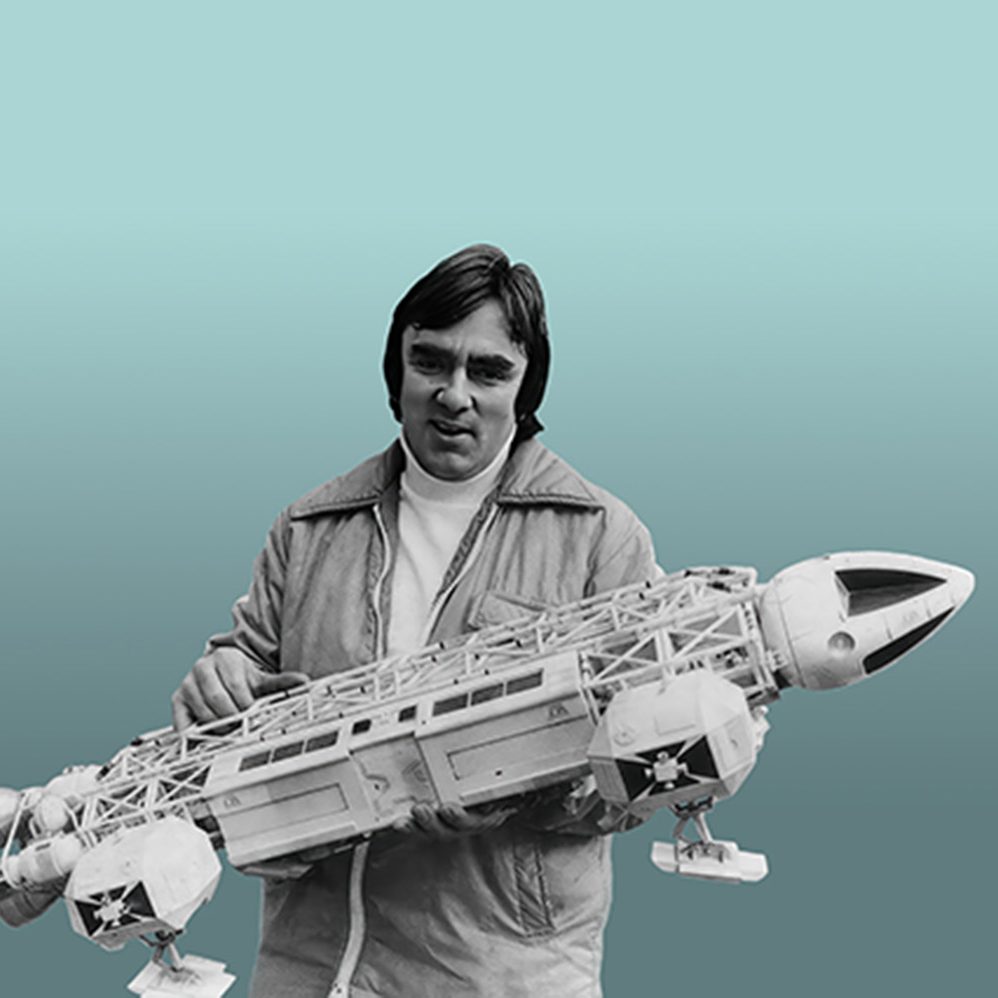
A Tribute to Brian Johnson
I just learned of the loss of one of the greatest influences in my life, and I thought this would be a good time to share a few thoughts.
I first saw his name when I was seven years old. It appeared in the closing credits of Space: 1999, four words on a spectacular animated background.
Special Effects. Brian Johnson.


I didn’t know what special effects were. I only knew that something had brought Moonbase Alpha to life on my TV screen. An amazing spaceship called an Eagle was the most extraordinary thing I had ever seen in my short life, and I immediately became obsessed with it. Learning what that special effects credit meant sent me to the library. It made me ask questions. It launched a lifetime of wanting to understand how the impossible was built. Once I understood what special effects were, I realized that Brian Johnson was the reason the Eagle and Moonbase Alpha felt so real.
A few months later, NBC aired a Gerry Anderson television special called The Day After Tomorrow. In the United Kingdom, they called it Into Infinity. Two families on a spaceship called the Altares, traveling at the speed of light toward Alpha Centauri. The effects were by Brian and his Space: 1999 team. I don’t have words for how much that little film impacted me. I was a child watching scientists and their children leave Earth for the stars, and I desperately wanted to join them on the adventure. To this day, I’m not sure there was a pile of media more targeted to my personal sensibilities. And again, Brian helped bring that world to life.
By late 1975, the Dinky die-cast Eagle toys had arrived. My mother knew what Space: 1999 meant to me and made me a deal: get good grades and she would get me an Eagle. I delivered straight A’s, so she delivered too. Then came Christmas 1976 and the Mattel Eagle. It was the big one. The playset that became the favorite toy of my entire childhood.
By the time The Empire Strikes Back came out a few years later, I knew exactly who Brian Johnson was. I was the kid who devoured The Art of Star Wars: The Empire Strikes Back, who read every behind-the-scenes book and magazine I could find. for me, these were foundational and sacred text. I knew Brian had worked on Alien — although I wasn’t old enough to see it yet. I had seen 2001: A Space Odyssey on television by then. To me, 2001 was — and still is — the milestone of all visual effects. The bar against which everything else gets measured. And Brian had been part of that too.
Then came Dragonslayer in 1981, and that film changed something in me. I’ve never been a fantasy guy. But Dragonslayer is my favorite fantasy film of all time, and it is because of what Brian and his team did with Vermithrax Pejorative. The realism of that dragon — the weight, the menace, the way it moved through the air — was unlike anything I had ever seen. It still holds up 45 years later. I still watch Dragonslayer and marvel at what they pulled off with practical effects and craft and obsessive attention to detail. That dragon is alive in a way most CGI creatures still aren’t. And then came Aliens. Amazing effects on a tight budget.

Dragonslayer (1981)
For decades, his name kept appearing on the films I loved most. He was the through-line of the visual language I grew up dreaming in.
I met him in 2018. We had tea in England, and I told him about a film I was developing called Persephone — a hard science-fiction feature about a deep-space mission. He loved the project. He agreed to consult on it. We hit it off immediately. He treated me as a fellow filmmaker, not as a fan. That meant everything. The man who had designed the Eagle Transporter — the spacecraft that started my love of all of this — was helping me design my own.
In February 2023, we had lunch in Bray, England. Bray Studios was where he and his team had built the magic of Space: 1999 nearly fifty years earlier. Over that lunch, I told him about a documentary I wanted to make — a film about how the Eagle, and the era it came from, had shaped a generation of dreamers. I told him I wanted him in it. He said yes immediately. Not for the money. Not for the publicity. He said yes because he loved the idea.
In December 2023, I returned to England with my camera crew and we filmed our first interview. Brian was generous with his time and his stories. He talked about how he had stumbled into special effects almost by accident — how a man in a pub named Les Bowie had offered him a job sweeping floors at a studio, and how that simple act had changed the trajectory of his life.


He talked about meeting two young Americans named George Lucas and Gary Kurtz at Bray Studios while working on Space: 1999, and how they had asked him to do a small film they were planning called Star Wars. He had been too busy. He talked about Kubrick. About Cameron. About the Oscars and the Special Achievement Award. He laughed about the absurdity of it all — a man who couldn’t pass his math exams to become a pilot, ending up with two Academy Awards on his shelf.
But what I remember most is the humility. Brian Johnson was one of the most important visual effects artists in the history of cinema. He never acted like it. He talked about his work the way a craftsman talks about his trade. He gave credit to the people who taught him. He gave credit to his teams. He never positioned himself above the work. He was the work.
In May 2024, I returned to England again. By then, we had built a full-scale Eagle Transporter cockpit with working lights, controls, and functional screens. I needed Brian to see it. I wanted him to be the first person to look into the cockpit of the spacecraft he had designed half a century earlier. We filmed him with it. We photographed him in front of M Stage at Pinewood — the soundstage where Space: 1999 had been filmed — and he stood next to me for the picture. The kid who had first seen his name in the closing credits at age seven was now standing shoulder to shoulder with him outside the very stage where it had all begun.

That photograph is one of the most meaningful possessions of my life.
The Eagle Obsession could not be what it is without Brian Johnson. His voice. His memories. His presence. The film is, in many ways, a love letter to the work he did and to the generation he inspired. He saw an early cut before he died. He told me he was proud of it. I will carry that with me forever.
Brian was eighty-six when he passed. He had a long, extraordinary life. He won every award there is to win. He worked with the greatest filmmakers of his era. He designed a spacecraft that will outlive all of us. But beyond the credits and the Oscars, he was a kind, generous, funny, and humble man who treated a kid from Arizona who had grown up watching his work as an equal.
He gave his time, his blessing, and most importantly, he gave his trust.
I will never stop being grateful.
Rest well, Brian.
The Eagle is still flying and will continue to forever.
— Jeffrey Morris Director, The Eagle Obsession